
Karnes County Court Records After Arrest
After a Karnes County jail arrest, the charge path depends on offense level and filing office. A booking can begin with a sheriff deputy, city police officer, DPS trooper, or another agency. The person may then be booked at Karnes County Jail, receive magistrate review, and get a court date or bond decision. The court record starts to take shape when the County Attorney, District Attorney, clerk, or court receives and files the criminal case paperwork.
The roster side and the court side serve different jobs. For custody, jail intake, and booking detail, use Karnes County jail inmate records. For booking photos, use Karnes County jail mugshots. For court records after an arrest, check the filed charge, case number, court, prosecutor, bond entries, warrant history, settings, and final disposition when one exists.
The Karnes County Court page adds a practical local detail. Criminal defendants receive a court date when released from Karnes County Jail, must keep address and phone information current with the County Clerk, and must attend all court dates. A missed setting can lead to a warrant and a new Failure to Appear charge.
Search Karnes County Court Records After Arrest
The official Karnes County Public Access portal is the first court-record lookup point. Research confirmed the portal as an official county link, but the current search fields were not captured because direct non-browser access was redirected or blocked. Use the defendant name, case number, or other fields shown in the live browser session. Then match the court case against the jail booking, bond, or custody status as needed.
- Confirm custody or the booking charge through Public Access, the sheriff, or VINELink.
- Open the official Public Access portal and search with the fields shown in the browser.
- For misdemeanor or county-court matters, check with the County Clerk or County Attorney if the case is not clear online.
- For felony or district-court matters, check with the District Clerk or the 81st Judicial District Attorney.
- Read the filed charge carefully, because a booking charge may be amended, reduced, dismissed, or replaced by a different prosecutor filing.
The portal screenshot from the county Public Access system documents the official starting point for Karnes court and jail record searches.
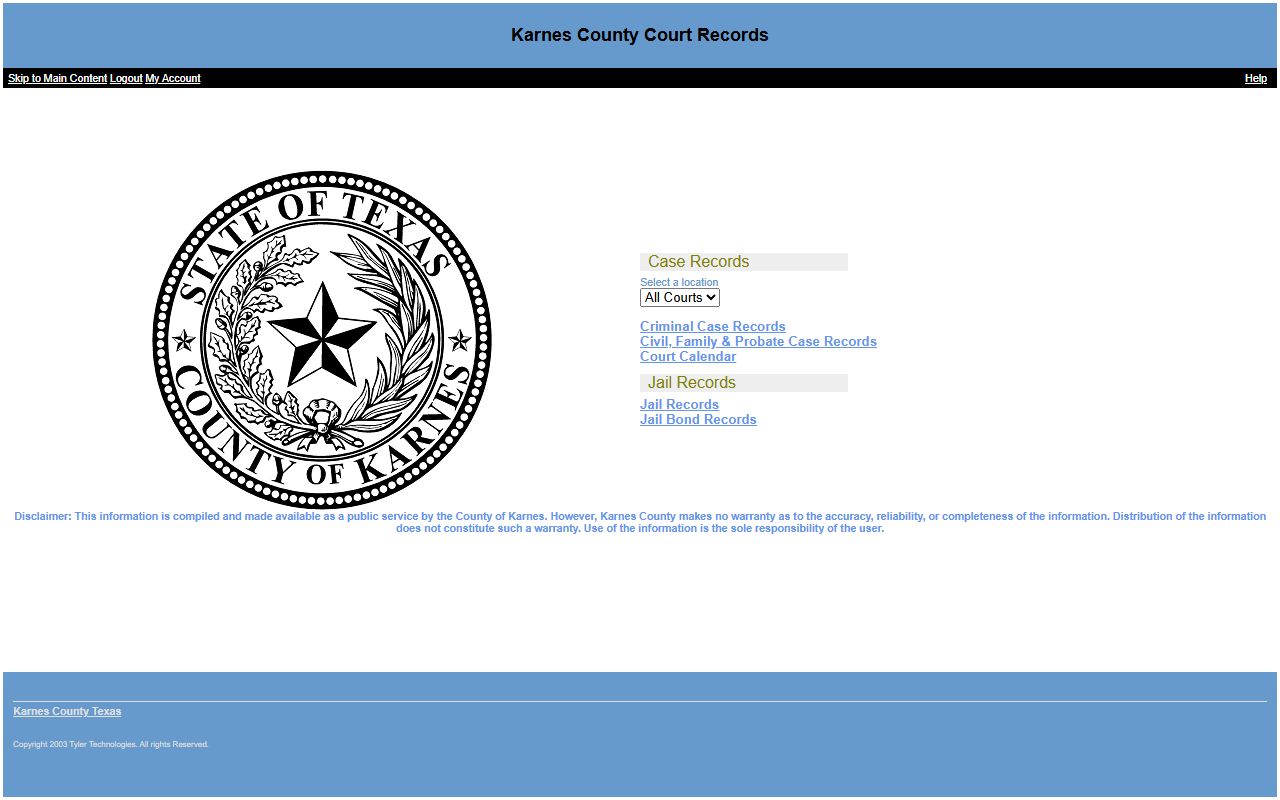
When the portal does not show the needed case, the clerk and prosecutor offices are the local follow-up sources.
Karnes County Courts and Prosecutors
Karnes County court records after a jail arrest may involve county-level or district-level offices. The County Clerk lists Jamie Leal at 210 W. Calvert, Suite 100, Karnes City, TX 78118, phone (830) 780-3938. The County Clerk page states that, effective May 1, 2026, hours are Monday through Friday, 8:00 a.m. to 5:00 p.m., closed noon to 1:00 p.m., with registers and doors closing at 4:45 p.m.
The District Clerk lists Denise Rodriguez at 101 N. Panna Maria, Suite 104, Karnes City, TX 78118, with phone numbers (830) 780-2562 and (830) 780-3065. District Clerk office hours are Monday through Friday, 8:00 a.m. to noon and 1:00 p.m. to 5:00 p.m. The County Attorney, Jennifer Tapia, handles many county-level prosecution functions at 101 North Panna Maria Avenue, Suite 302, Karnes City, TX 78118, phone (830) 780-3736.
Felony prosecution is handled by the 81st Judicial District Attorney. The county page lists Audrey Gossett Louis as District Attorney for Karnes, Wilson, Atascosa, Frio, and La Salle counties. The office address is 1105 A St., Floresville, TX 78114, phone 830-393-2200, with the district website at 81stda.org.
The District Clerk page screenshot shows one of the official record offices used after felony-level charges move into district court.
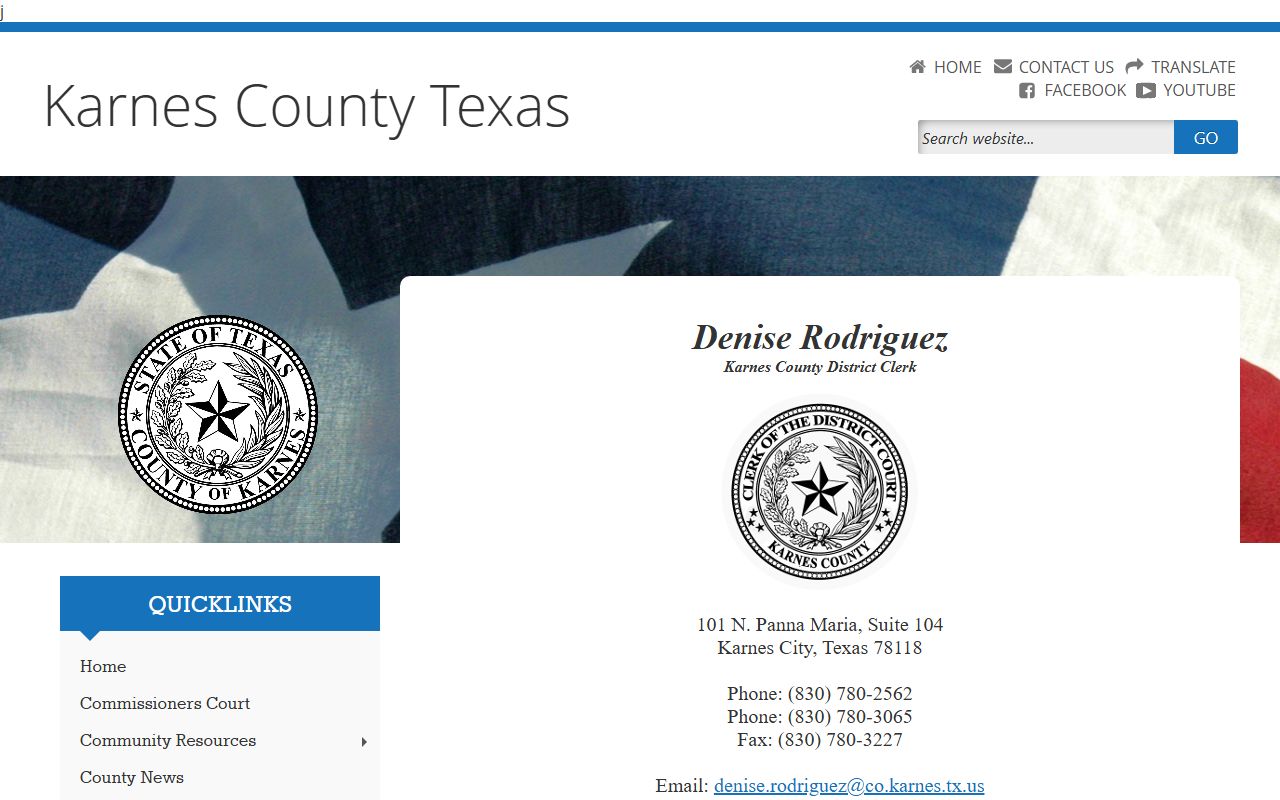
The clerk office that holds the record depends on the charge level and court assignment.
Karnes County Charging Documents
A jail arrest does not always match the final court charge word for word. The arresting agency may book a person under one offense description. The prosecutor may later file a complaint, information, or indictment with different wording, charge level, count structure, or disposition. A complaint is often a sworn charging document used early in misdemeanor or probable-cause proceedings. An information is a prosecutor-filed charging document used for many non-indictment cases. An indictment is a grand-jury charging document for felony prosecution.
| Document | Who Files It | Common Use | Why It Matters |
|---|---|---|---|
| Complaint | Officer or prosecutor | Early misdemeanor or probable-cause filing | Starts or supports the criminal accusation. |
| Information | Prosecutor | Many county or non-indictment cases | States the formal charge the state will pursue. |
| Indictment | Grand jury | Felony prosecution | Shows the felony charge approved for district-court prosecution. |
Karnes County Charge Status
Charge status is a snapshot of the court case, not a judgment about guilt by itself. A pending charge means the case has not been resolved. An amended charge changed from the original filing. A reduced charge is lowered by plea negotiation, prosecutor action, or court handling. A dismissed charge ended without a conviction on that count. A conviction is a final finding or plea result, and it is different from an arrest.
| Status | Meaning in a Court Record |
|---|---|
| Pending | The case or count remains unresolved. |
| Amended | The charge, filing language, or count was changed after the first filing. |
| Reduced | The offense level or charge was lowered by plea or prosecutor action. |
| Dismissed | The case or count ended without conviction on that charge. |
| Conviction | A final adjudication, verdict, or plea result, separate from the arrest event. |
| Failure to Appear | A missed court date can trigger a warrant and a new charge under local County Court guidance. |
Karnes County Bond Records
Bond and release after a Karnes County arrest are governed by Texas Code of Criminal Procedure Chapter 17. Local bond information may appear in jail bond records in Public Access, in court records, or through sheriff and jail phone verification. Karnes County did not publish a jail bond desk page or accepted payment methods, so do not assume a credit-card kiosk, cashier's check rule, online bond payment, or 24-hour bond window.
| Bond Type | How It Works |
|---|---|
| Cash bond | Money posted directly for release, subject to court and jail rules. |
| Surety bond | A licensed bail bond company posts security for a fee. |
| Personal bond or PR bond | Release based on a written promise and conditions rather than full cash security up front. |
| No-bond hold | A court or agency hold prevents ordinary release on that matter. |
| Detainer | Another agency, parole authority, ICE, or federal authority may keep the person in custody. |
Call the sheriff or jail at (830) 780-3931 before bringing money or documents. Also confirm whether the person is in the county jail, the GEO/USMS facility, or ICE custody, since each custody system has a different release path.
Karnes County Warrants After Arrest
No official Karnes County active warrant search page was located in the research. Warrant information may still surface through court records, the sheriff's office, clerks, prosecutors, and public-records requests. The County Court page warns that missing a scheduled hearing can lead to a warrant and a new Failure to Appear charge by the County Attorney. The County Attorney page also lists a hot-check contact for people trying to resolve a pending matter before a warrant issue grows.
- Arrest warrant
- A court order issued after probable cause for a criminal offense.
- Bench warrant or capias
- A judge-issued warrant, often tied to failure to appear or case noncompliance.
- Search warrant
- A warrant that authorizes a search, not a custody listing.
- Fugitive hold
- A hold tied to another jurisdiction's warrant.
Once a person is arrested on a warrant and booked into Karnes County Jail, the custody event may become a jail record. If the warrant belongs to another county, a federal court, parole, or ICE, the local record may show only a hold or the person may be transferred.
Charges vs Convictions
An arrest charge, a filed charge, and a conviction are different records. The arrest charge is the accusation used at booking. The filed charge is the prosecutor's formal court accusation. A conviction is the final finding, plea, or adjudication. Public court records after a jail arrest can show any of these stages, so the date and status of the entry matter.
| Point of Comparison | Charge | Conviction |
|---|---|---|
| Stage | Accusation or filed count | Final verdict, plea, or adjudication |
| Proof level | Probable cause or prosecutor filing standard | Beyond a reasonable doubt or accepted plea |
| Can change | May be amended, reduced, added, or dismissed | Changes only through post-judgment legal process |
| Meaning | Not proof of guilt | Formal criminal case outcome |
Karnes County Sealed or Expunged Records
Texas public access law does not mean every court record stays public forever. Texas Code of Criminal Procedure Chapter 55 governs expunction of qualifying arrest records. Expunction is a court process to remove qualifying records, often after specific dismissal, acquittal, or eligibility conditions. Sealing or nondisclosure is different from expunction and can limit public access without treating the arrest as if it never existed.
| Point of Comparison | Sealed or Nondisclosed | Expunged |
|---|---|---|
| Public visibility | Hidden from many public searches | Removed or treated as not existing for qualifying purposes |
| Law enforcement access | May remain available to certain agencies | Very limited after a proper expunction order |
| Route | Court order under applicable Texas law | Petition and order under Chapter 55 where eligible |
Important: A dismissed charge is not automatically removed from every public or agency system without the proper court process.
Karnes County Court Record Laws
Texas Government Code Chapter 552, the Texas Public Information Act, covers access to existing government records and the response framework for public requests. Section 552.108 can protect some law-enforcement information, but subsection 552.108(c) is commonly cited for the rule that basic information about an arrested person, an arrest, or a crime is not excepted. Texas Government Code Chapter 411 governs criminal history record information and dissemination, including state criminal history systems.
For local requests, Karnes County instructs requesters to use the Public Information Request form, send it to the County Attorney's Office at 101 N. Panna Maria Ave., Suite 302, Karnes City, TX 78118, or email public.records@co.karnes.tx.us. The county says it responds within ten business days. Ask for existing records, such as a case filing, booking record, or bond record, instead of asking the county to create a new explanation.